
Austin Parks and Recreation Department, Oakwood Cemetery Chapel, exhibit “To Emancipate”.
The Communities
Wheatville
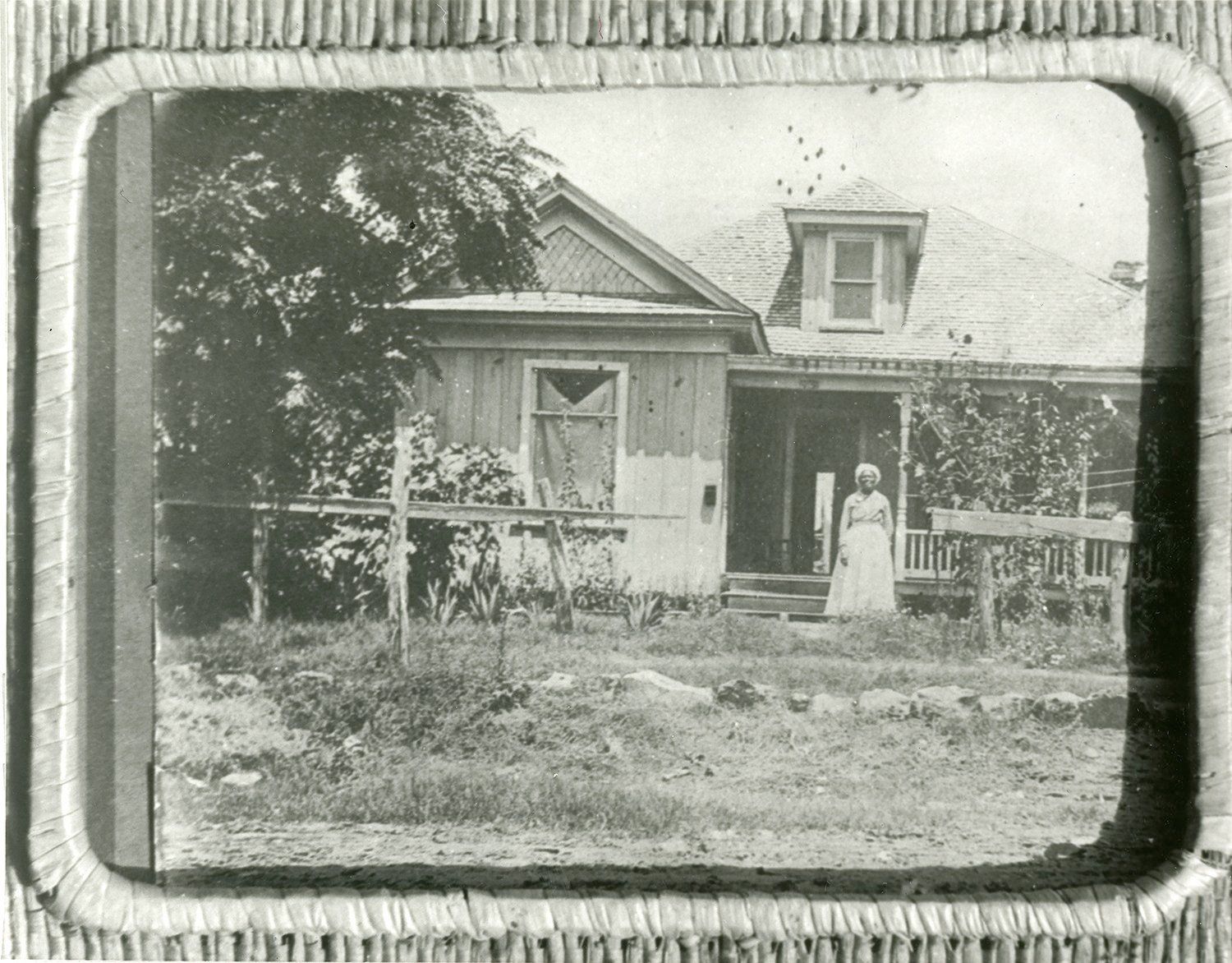
A black and white copy photograph of an African American woman standing in front of a house with a front porch in the Wheatville subdivision, dating about 1900s. Citation: [PICA-36047], Austin History Center, Austin Public Library.
Wheatville was founded in 1869 by freedman James Wheat. Wheat grew corn on the plot of land at 2409 San Gabriel Street and became Wheatville’s first landowner. The community was established along Shoal Creek, between West 24th and 26th streets and Rio Grande Street. Residents of the freedom community held various jobs, including construction workers, merchants, domestic workers, and blacksmiths. Wheatville remained largely rural and removed from the city of Austin until the twentieth century.
The Franzetti building at 2402 San Gabriel Street is said to have been built by freedman and carpenter George Franklin in 1869. The two-story stone structure formerly housed a grocery store among other businesses, and it also served as an early church. This is the only building that remains that was part of the community and was designated a City of Austin Local Historic Landmark in 1977. Today, the building houses a restaurant, and the surrounding neighborhood consists entirely of apartments, condos, and student housing.
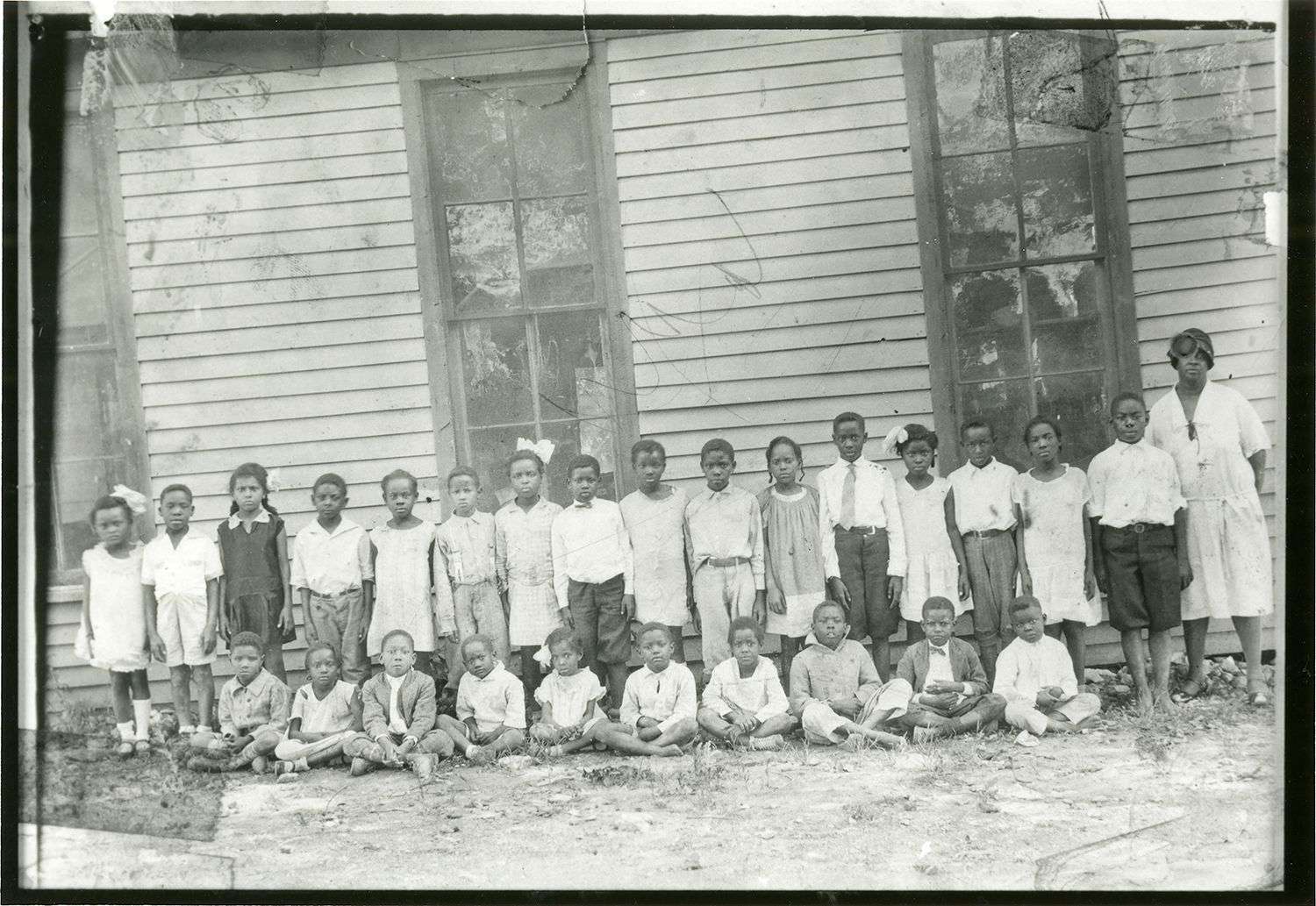
Group portrait of students at Wheatville School with Melvin Stewart seated second from right and Isaac Chapman seated third from the left, 1920. Citation: [PICA-36025], Austin History Center, Austin Public Library.
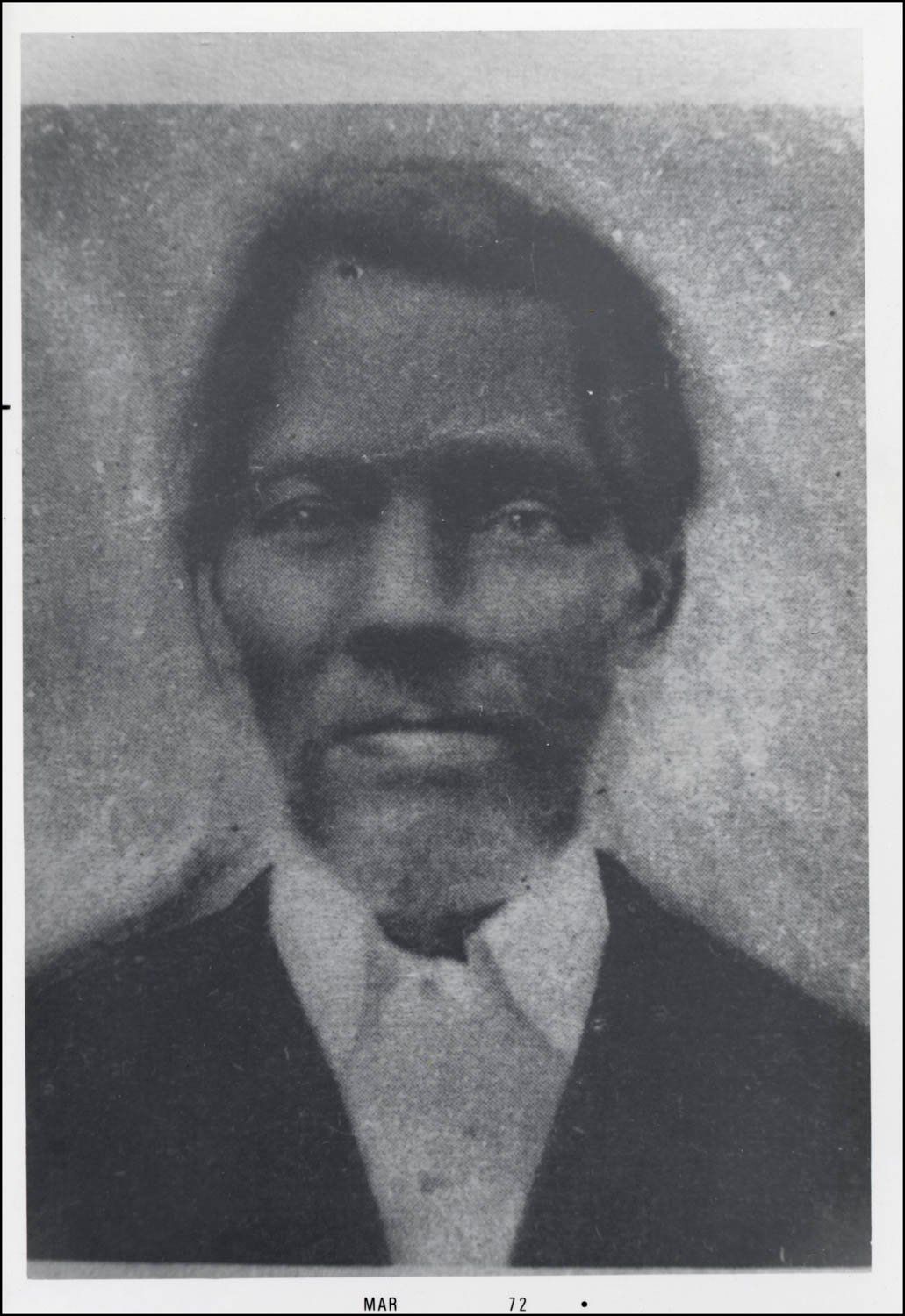
Rev. Israel Jacob Fontaine. Citation: [PICB-02906], Austin History Center, Austin Public Library.
Reverend Jacob Fontaine, a prominent Baptist minister, settled in Wheatville in the late 1860s. He helped found the New Hope Baptist Church in 1889 and was instrumental in establishing the St. John Regular Missionary Baptist Association. New Hope Baptist would move to another part of Wheatville a few years later. Fontaine also published one of the first African American newspapers in Texas, the Gold Dollar, which he operated out of the Franzetti building. In 1904, the Pilgrim Home Baptist Church organized in the community.
The Wheatville community had established an informal school in 1876, which 66 students attended. The Travis County Court designated surplus building funds from its sixth district to build free public schools for African Americans in 1877. The Wheatville school opened in 1881. Prominent Black Austin educator, W.H. Passon, served on the school staff and would later become its principal. In 1896, the school had 60 students enrolled, and in 1904, there were 97 students in attendance.
At its peak around the turn of the century, Wheatville had 300 residents. The community remained relatively isolated until the white population decided to expand westward for the varied landscape and the better drainage the area offered. As land values in the area increased, the city began imposing restrictions on building quality and on raising livestock within city limits. Additionally, chronic pollution and disinvestment compelled Black residents to leave Wheatville. A 1913 social survey reported that the accumulation of garbage and waste in the streets of Wheatville was the result of a lack of city sanitation service on the community. The report also noted that city garbage wagons often dumped their loads into the community's streets and alleyways before reaching the dumpsite.
Even through these hardships, Black residents remained, and 177 students were still enrolled at the Wheatville school in 1914. However, after the 1928 city of Austin plan to place public facilities for Black Americans, such as schools, recreation facilities, and health clinics, in East Austin, the majority of families chose to relocate. The Wheatville school closed in 1932, and the community virtually vanished by the mid-1930s. The Wheatsville Food Co-op, founded in 1976, was named in memory of the community.
Information provided by the African-American Settlement Survey Travis County, Texas prepared by prepared by Hicks & Company Elizabeth Porterfield, MSHP for Travis County Historical Commission.
This information was supplemented by archivist at the University of North Texas, Michelle Mears, from her book And Grace Will Lead Me Home African American Freedmen Communities of Austin, Texas, 1865-1928.
We recognize that this research is ongoing, drawing extensively from historical documents, archives, and oral histories passed down through generations.
Given the evolving nature of information, it is important to note that details may change. And while inaccuracies may arise, we actively strive to update our records as we acquire new knowledge.
Map provided by Austin Parks and Recreation Department, Oakwood Cemetery Chapel, exhibit “To Emancipate”.
Click on the map to zoom in and explore a specific community.To view a full list of all communities, click the “i” icon in the top-left corner of the map.
