
Austin Parks and Recreation Department, Oakwood Cemetery Chapel, exhibit “To Emancipate”.
The Communities
Early history of South Side
The South Side or Bouldin Creek Freedom Community was organized by freedpeople following emancipation near the Bouldin plantation in South Austin. The community was located south of the Colorado River, between East and West Bouldin Creeks. Early residents organized a community school, which was incorporated into Austin’s Public Schools by 1895 when the Board of Trustees agreed to rent a building on W Elizabeth Street for “the South Austin Colored School.” Even though 47 students regularly attended the school by 1896, it was closed because the Board found the building’s upgrades were too expensive. As a result, students traveled to attend school in adjacent Freedom Communities, such as Clarksville, where their teacher, Mrs. Barton, was transferred.
Early resident Robert S. Stanley, with his brothers, built a stone house at 1811 Newton Street (now West Mary Street) in 1895, demonstrating the craftsmanship of the community’s earliest residents.
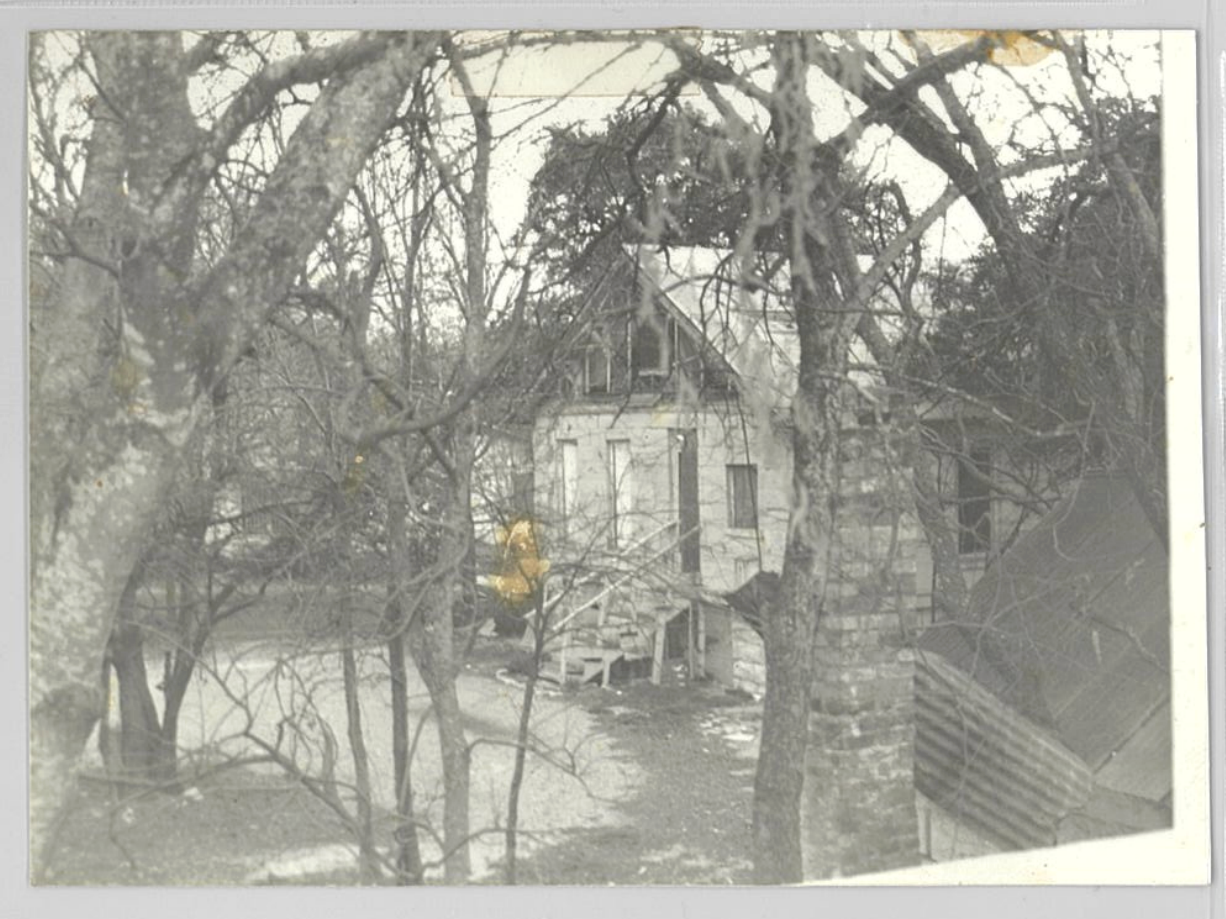
“Photograph of the Stanley House, Undated”
The Stanley House featured a basement, which was uncommon in South Austin, and was heated with “four potbelly stoves” because it lacked electricity. His wife, Jennie Stanley, maintained a general store there, at present-day 200 West Mary Street.

The Austin Board of School Trustees moved to reopen the community’s school in 1901, renting the building on West Elizabeth Street just north of Stanley’s home for the “South Austin Colored School.” A neighboring white landowner, J.T. Brackenridge, agreed to deed the school to the city on the condition that it be used exclusively to establish a school for colored students. The school was reopened in 1905 as the Brackenridge Colored School. Led by the principal and teacher A. Jackson Jr, the school served 61 students that year. The Brackenridge School was a one-story wooden building with board-and-batten siding, 6/6 wood sash windows, and a square-columned porch entrance located at 319 West Elizabeth Street. The earliest recorded photograph of students and teachers outside the school building dates to the 1910s and is included below.
Early residents of the South Side Freedom Community worked as seamstresses, laborers, masons, or businesspeople. One of the families that purchased land from Mr. Armstrong in the Swisher addition was the Wells. A single mother to several children, Mrs. Cisco Wells purchased a house at 1705 Newton Street “from her own estate,” built in 1910 by W.B. Loveless, where she’d live with her children. The structure consisted of two rooms with a modest central hallway, board-and-batten siding, wooden porch posts, and wooden sash windows.
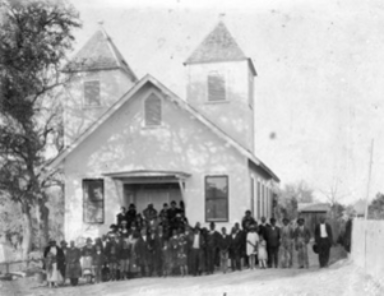
The community organized several churches beginning in the early 1900s when white landowners began partitioning and selling adjacent land. The St. Annie’s Methodist Church was built in 1915 on the former homesite of the Loveless family, the white landowners who’d arrived in South Austin in 1895, had previously rented to families, and decided to sell their land and move because of the influx of Black families following the construction of the school. Its earliest trustees included Wallace Rose, T.W. Plumber, L.P. White, John White, and Joe Broadnax. Community members organized the Goodwill Baptist Church at 1700 Newton by 1903, with H. E. Russel and Richard Morris serving as the first members of the Board of trustees.
The Friendly Will Baptist Church was organized in 1924 at 414 Johanna Street, with Aaron Pyburn, Allan Deen, Clarence Williams, Guss Atwood, Elijah Morris, Dewie Morris, and John Morris serving as the founding Board of Trustees. Below is a photograph of the church, taken shortly after it was built.
The following persons were members of the founding congregation, according to the church’s website: “Sarah Atwood , Charley Bell , Fannie Bell , Wesley Bell , Georgia A. Canady , Henry Canady, Allen Dean, Randell Jackson , Beauty Manor, D. Morris , Dewey Morris, Elijah Morris, John Morris, Minnie Morris, Precious Morris, Eula Mae Page , Ethel Spence, C. O. Williams, Matilda Williams, and Lula Wright”
(1) National Register of Historic Places Registration Form, Willie Wells House, page 12
(2) “Robert S. Stanley House Photograph #1,” The Portal to Texas History, January 1, 1996
(3) National Register of Historic Places Registration Form, Willie Wells House, page 12.
(4) Austin American Statesman, September 2, 1905, page 3.
(5) “Students at Brackenridge Elementary,” undated circa 1900s Portal to Texas History – Austin History Center
(6) Bouldin Creek Neighborhood Plan 2002, page 12.
(7) National Register of Historic Places Registration Form, Willie Wells House, page 12.; Travis County Clerk Records, Deed Record 251, page 519.
(8) Austin History Center
(9) Historic Marker Application, page 13
(10) Friendly Will Baptist Church, https://www.fwmbc.com/about-us/
Map provided by Austin Parks and Recreation Department, Oakwood Cemetery Chapel, exhibit “To Emancipate”.
Click on the map to zoom in and explore a specific community.To view a full list of all communities, click the “i” icon in the top-left corner of the map.
