
Austin Parks and Recreation Department, Oakwood Cemetery Chapel, exhibit “To Emancipate”.
The Communities
Early History of Barton Springs
The Barton Springs Freedom Community was organized in South Austin around 1866 by freedpeople who lived on or near the Goodrich plantation estate and its slave cemetery. Early residents formed a congregation after emancipation and built a church adjacent to the cemetery sometime around 1878, on land promised to them by the Goodrich family (1). The community organized a school, and its trustees, James Morris, Benjamin Franklin, and Elijah Morris, purchased an adjacent plot of land from Frank Goodrich to establish a “school community” on August 28th, 1884 (2). The church’s trustees, Stephen Franklin, Wiley Barrow, and Thomas Jones, purchased the northeastern part of a six-acre tract from W.E. Goodrich on January 5th of 1885, securing legal title to the land upon which the historic cemetery was located (3).
The community convened with neighboring freedom communities through the turn of the century, working to secure resources for various mutual-aid projects and to maintain their presence in South Austin. For example, the Barton Springs Baptist Church hosted one of the St. John’s Association’s monthly executive meetings in late January of 1904 (4). Preachers traveled from across the district (of which Reverend L.L. Campbell was the moderator) to the church in South Austin to discuss raising funds for the erection and operation of a colored orphanage in northwest Austin, which was built two years later as planned. Early residents of the Barton Springs Freedom Community struggled to reach downtown, though, until the construction of the Congress Avenue Bridge in 1910 made crossing the Colorado River easier.
The community’s school was incorporated into the St. Elmo School District in 1914. It was recorded on a “Topographic and Road Map of Travis County” prepared by the Travis County Engineering Department in 1932 (5).
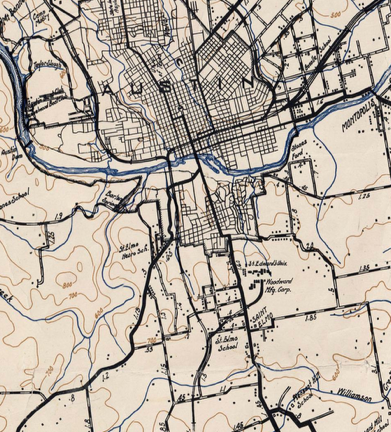
“Topographic and Road Map of Travis County, 1932”
The school was divided into St. Elmo No. 1 and St. Elmo No. 2. During the 1934-1935 school year, St. Elmo No. 1 had 25 students, an average attendance of around 15, and one teacher assigned to all seven grades offered (6). St. Elmo No. 2 had a population of 20 students that year, with an average attendance of around 20, and Miss J.E. Henry was assigned to all seven grades offered. The 1934-1935 attendance records for both schools reflect the following surnames: Alexander, Atwood, Bell, Brewer, Brown, Davidson, Franklin, Houston, Hughes, Hunt, Jones, Kincheon, Lewis, Morris, Overton, Robinson, Scales, Smith, Watters, and Woods. The St. Elmo School District was incorporated into the Austin Independent School District in 1937, and the following year, the community’s school building was repurposed as a church.
The Barton Springs Freedom Community was anchored by the Barton Springs Baptist Church and Cemetery site, and its congregants worked to mobilize the institution to preserve the community’s presence through the midcentury. The cemetery contained over 2,000 burials, according to the descendants of those interred there, and the latest recorded burial occurred in 1946, though Deacon E.M. Robinson claimed it remained in use as late as 1951 (7). Their church building at 2021 Goodrich Avenue was destroyed by fire on June 29th of, 1947, with losses exceeding $2,000, according to Reverend T.H. Wright (8). They constructed a new wooden-frame church on cinder blocks shortly thereafter, designed by Emmit Watters and built by his cousin (9). A portion of the grounds was surveyed and sold in 1963 by the heirs of the aforementioned trustees, but descendants claim the survey misrepresented the cemetery's scope, underrepresented its boundaries, and ultimately misunderstood the chain of title surrounding the site. Church membership declined sharply following the passing of Reverend T.H. Wright in December of 1966, but descendants continued to maintain the property, and Reverend Sampson was later chosen to pastor the church.
Historians surveyed the Barton Springs Baptist Church Cemetery property in 1977 and recorded several graves that retained markings, including but not limited to those of Maria Bell (1913), Lizzie Edwards (1922), L. Eloise Henderson (1928), Francienne Neere, and one unnamed person (1915) (10). Elijah Morris’ great-great-great-granddaughter, Elijah “Lili” Williams Dotson, organized the Barton Springs Heritage Association in coordination with other descendants to preserve the site’s history and heritage (11). In response to their advocacy, the City of Austin rezoned the Barton Springs Baptist Church and Cemetery Site that fall from a Family Residence (SF3) district to a Family Residence-Historic (SF-3) district, thereby providing zoning-based protections for the site’s recognized historical and architectural significance (12).
The original trustees of the property voted to authorize and direct their trustee, Mrs. Mary Alice Clark Wright, to convey the property to the new organization at a June 30th meeting in 2006, under the condition that the relatives of the interred be given access to the property for “upkeep and visitation purposes (13). The Travis County District Court granted the Barton Springs Heritage Association a default judgment on April 30th of 2007, granting trustees Clem B. Lewis, Thomas Bellinger, E.R. “Effie” Robinson Edwards, and Mary Alice Wright Clark to “take action on behalf of the Barton Springs Church and Cemetery” and convey the property to the Barton Springs Heritage Society for its preservation. The District Court reported in its final judgment that
“The site is a cemetery containing gravesites of freed slaves and/or descendants of freed slaves. As such, the site is a significant reminder of the shameful history of slavery and the strength of freed slave communities, religiously as well as socially and politically, in the United States, Texas, and our local communities here in Austin…the cultural, historic, and religious value of this site substantially outweighs any potential monetary value, if any, that could be obtained through the commercial sale of the property for future development.”
On May 1st of 2007, Mary Alice Wright Clark granted the Barton Springs Heritage Association ownership of Lot 2 of the Goodrich Avenue Addition. The Texas Historical Commission dedicated and declared the site of the Barton Springs Baptist Church Cemetery (THC Cemetery No. TV-C160) for cemetery purposes on September 15, 2015, acknowledging that the property held “human graves.
References
(1) “Church News,” The Villager, November 25, 1983, page 8.
(2) Travis County Clerk’s Office, Deed Record 67, “Deed from Frank Goodrich to James Morris et al., pages 313-314.
(3) Travis County Clerk’s Office, Deed Record 144, Deed from W.E. Goodrich to Stephen Franklin et al., pages 408-409
(4) “Colored Orphans’ Home: Association Having This Object Now in Session,” Austin American-Statesman, January 31, 1904.
(5) J. G. Morgan and J. E. Morgan, “Topographic and Road Map of Travis County,” Travis County Engineering Department, 1932.
(6) Travis County Historical Commission, “African American Rural Schools of Travis County,” 61-63.
(7) Mike Todd, “"Preservation: Former Congregation rededicates cemetery, vows to reclaim site,” April 17, 1993.; Dona Kurtz, “Barton Springs Baptist Church Cemetery aka Goodrich Cemetery,” Austin Genealogical Society, transcribed on February 2, 2006.; Linda Kerr, “A ‘lost’ cemetery hides forgotten lives and times,” Austin American-Statesman, May 29, 1977.
(8) “Fire Destroys Baptist Church.” Austin American-Statesman, June 30, 1947.
(9) "Descendants want church, cemetery of freed slaves protected.”
(10) Betty Baker and Pat Brannen, “Barton Springs Baptist Church Cemetery, September 27, 1977
(11) Elijah “Lili” Williams Dotson Obituary,” Dignity Memorial, https://www.dignitymemorial.com/obituaries/pflugerville-tx/elijah-dotson-12293388
(12) “Ordinance No. 930401-0,” City of Austin, April 1, 1993.
(13) Ramona Clark-Kelly, left, and Durotha Reyes examine one of the gravestones. Photograph by Larry Kolvoord, Austin American-Statesman, April 17, 1995.
Map provided by Austin Parks and Recreation Department, Oakwood Cemetery Chapel, exhibit “To Emancipate”.
Click on the map to zoom in and explore a specific community.To view a full list of all communities, click the “i” icon in the top-left corner of the map.
