
Austin Parks and Recreation Department, Oakwood Cemetery Chapel, exhibit “To Emancipate”.
The Communities
Early history of Shoal Creek/West Austin
The Shoal Creek or West Austin freedom community was located along the banks of lower Shoal Creek above Fourth Street. It appears that the early community was largely formed along the eastern edge of the creek and may have expanded both westward and northward in subsequent years (1). Early residents of the community organized a church in the early 1870s at the home of a young laundress named Tempie Washington, who lived on West Avenue with her husband Phillip and their children (2). By 1873, the congregation, led by Minister Frank Green, had relocated the church to a plot of land at the northwest corner of Block 101, just a few blocks north of the community (3). They worshipped on this property in a rudimentary “barracks”- type structure, and by 1874, the church was home to the Texas American Methodist Episcopal Conference Connection High School and Institute.
The West Avenue, or West Austin, school was opened in September of 1897 under the supervision of Principal Wesley H. Passon and teachers Miss F. L. Collins, Mrs. Ada Hubbard, and H. A. Maxwell (4). The school was located at the southwest corner of West Fifth Street and West Avenue. The 1897-1898 Teachers’ register reflects that many of the Black adults living in this community worked domestic jobs for the wealthier white families living nearby, including but not limited to “porters, cooks, laundresses, housekeepers, seamstresses, watchmen, janitors, and drivers” (5). Though the school served a large portion of the city’s Black students, it was not well maintained by the city. According to the school board's 1901 meeting minutes, the roof leaked excessively, the desks and window shades needed repair, and the boys' and girls' “closets” or bathrooms were insufficient to serve the school's needs and lacked seats (6).
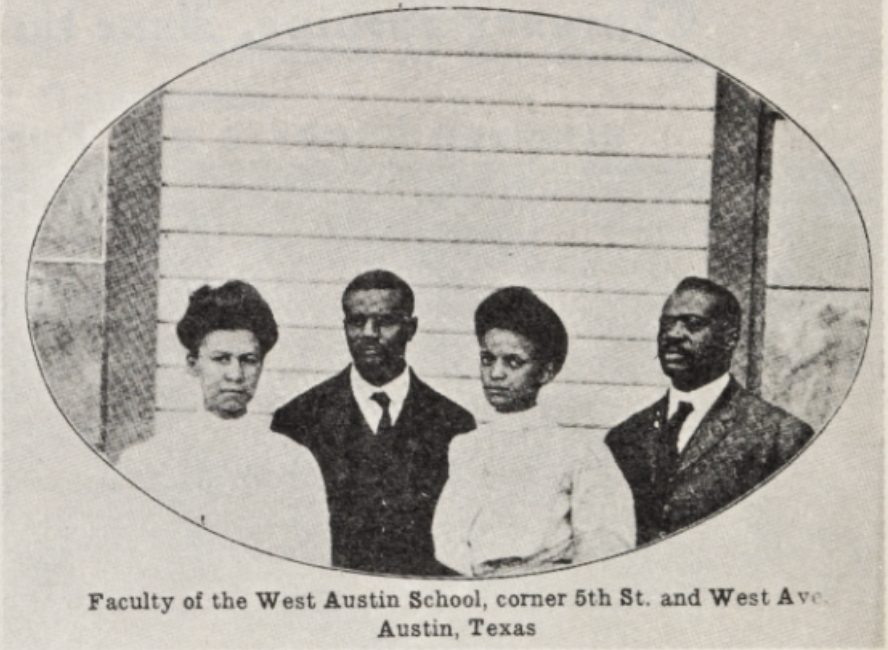
Wesley H. Passon was recorded as the principal of the West Austin (Colored) School from 1897 to 1904. W. T. McCall served as principal in 1905, and teachers Robert Davis, Miss Laura E. Pierce, and Miss Parthenia Polk were assigned (7). Around 288 students attended the school by 1905, according to the 1905 City Directory. Wesley H. Passon returned as principal by 1906 upon McCall’s passing, and teachers Miss L. E. Pierce, Miss Parthenia Polk, Mrs. L. E. Morton, and Timothy Chandler were assigned. Pictured below is a portrait featuring some of the West Austin School’s staff.
When Mrs. Morton was promoted to principal of the South Austin Colored School, the school board appointed Miss Addie Clements to teach at the West Austin Colored School. At least 227 students were enrolled in the school by 1909 (8). Principal Wesley H. Passon kept a diary or journal documenting the school’s affairs. Among the recorded notes is documentation of teachers’ plans to adjourn school early in the morning, “about 10:30”, to allow the children to attend Booker T. Washington's visit to Austin on his 1911 tour through Texas at the Sam Houston College that afternoon (9).
Works Cited
(1) Michelle Mears, And Grace Will Lead Me Home, 47-51.
(2) Metropolitan African Methodist Episcopal Church, https://www.metroame.org/our-history
(3) Metropolitan African Methodist Episcopal Church website
(4) Michelle Mears, And Grace Will Lead Me Home, 52.
(5) Mears, And Grace Will Lead Me Home, 47.
(6) Jayme Mathias, Minutes of the Austin City Public Schools Board of Trustees, 121.
(7) Mears, 163; Mathias, Minutes of the Austin City Public Schools Board of Trustees.
(8) Jayme Mathias, Minutes of the Austin City Public Schools Board of Trustees, 304.
(9) Austin History Center, Wesley H. Passon Journals.
Map provided by Austin Parks and Recreation Department, Oakwood Cemetery Chapel, exhibit “To Emancipate”.
Click on the map to zoom in and explore a specific community.To view a full list of all communities, click the “i” icon in the top-left corner of the map.
