
Austin Parks and Recreation Department, Oakwood Cemetery Chapel, exhibit “To Emancipate”.
The Communities
Early History of Masontown
Freedpeople organized the Masontown community shortly after emancipation, southeast of Waller Creek between E 3rd, E. 6th, and Chicon streets.(1) The community is named for African American brothers Sam Jr. and Raiford Mason, who’d lived South of Austin with their parents, Sam and Dicey, since they were brought there by their enslaver, Thomas Jones, in the late 1840s.(2) According to probate records, specifically the eighth provision of the 1835 will of Edmund Jones, Thomas Jones was willed “Sam[,] Dicy his wife[,] and child Isham.” UT Professor Dr. Tara Dudley recently established the connection between the Joneses and the Masons in her forthcoming chapter, “Slavery and Sovereignty in Stone: The Mason Family in Austin, Texas,” to be published shortly in the co-edited Volume Rewriting American Architecture: Contesting the Myths of National Culture. Masontown was home to many of Austin’s skilled craftsmen and laborers, even more so in subsequent years as industrial and transportation development on adjacent lands attracted newcomers.
Masontown formed around the Masons' property holdings beginning in the late 1860s. Sam Sr., George, and Raiford Mason purchased lots 7, 8, 9 from Block 182, a plot of land located at the south-eastern corner of Water (E 1st) and Trinity, from James P. Cope on July 31st of 1867.(3) The Mason family lived in the area in subsequent years, as the 1870 Census records Samuel and Dicey Mason living with their four younger children, Vina, Harriet, Charles, and Laura Mason, while with their sons, Raiford, Henry, George, and Sam Jr. lived nearby on adjacent plots of land with their families.(4) As evident in Figure 1, a portion of Augustus Koch’s 1887 Bird’s Eye View Map of Austin, the construction of the Houston and Texas Central Railroad near their properties in 1871 bisected the community.(5)
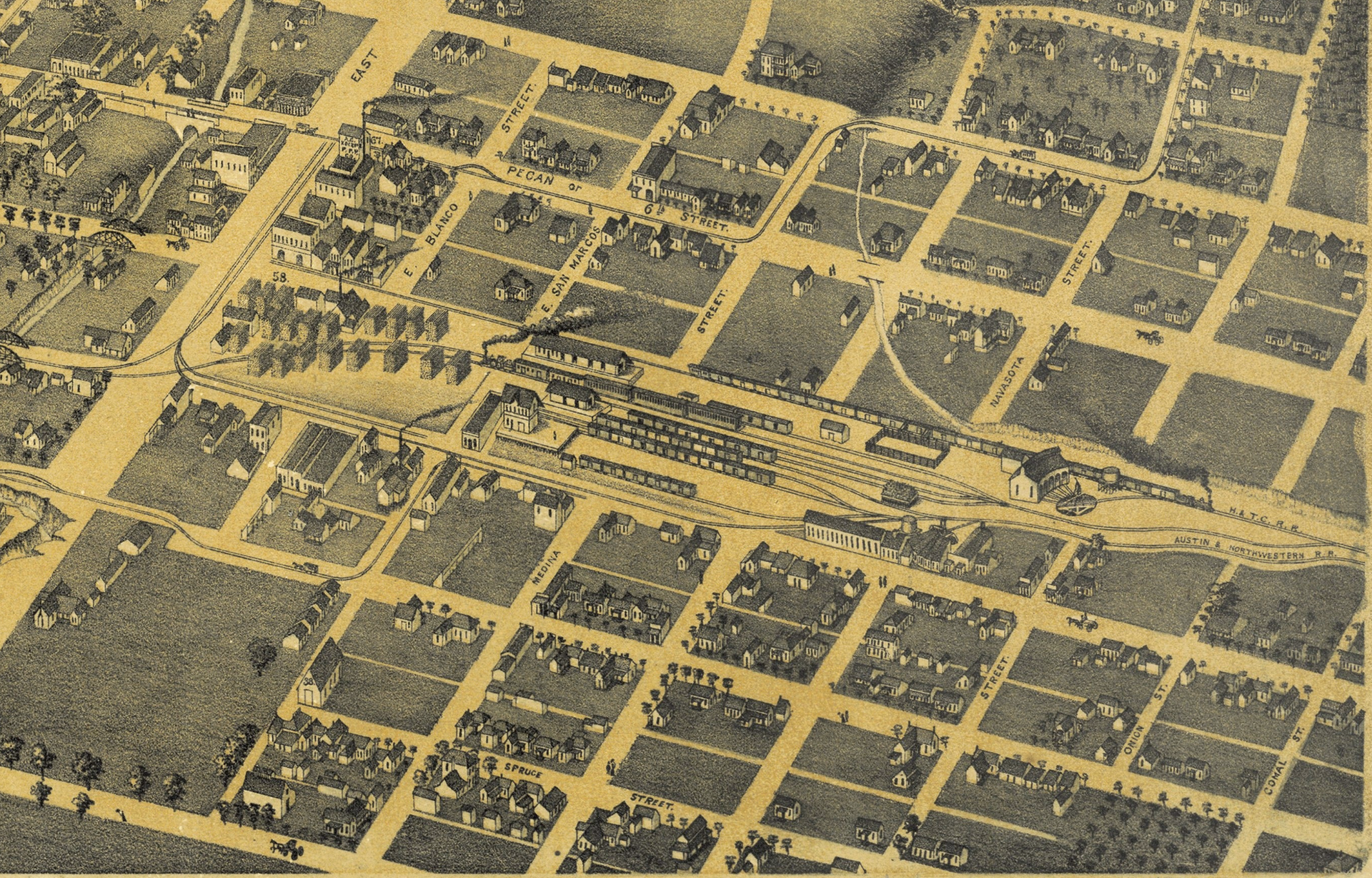
Figure 1: [Masontown on Augustus Koch’s 1887 “Bird’s Eye View Map of Austin”]
Historical records demonstrate that the railroad’s construction also attracted a host of new and established families to (re)settle nearby in later years. The Wilsons were among the earliest of the freedmen families who purchased land adjacent to the Masons that year. Samuel Wilson and Nancy Huddleston were married on July 23rd of 1866 by Reverend Jacob Fontaine of the First (Colored) Baptist Church.(6) Samuel Wilson’s voter registration in Travis County on June 1st of 1867 indicates that he’d resided in Texas since at least 1853.(7) The Wilsons purchased lots five and six from block five of the subdivision of outlot Number 3 in Division “O” of the City of Austin, presently known as 1308 E. 4th Street, on October 10th of 1871, from Oliver J. Peck for $450.(8) They lived there with their son, Frank, and later opened a grocery store on this plot where Samuel and Frank would work for several years. Their store sold cloth, ice, and other goods.(9)
Masontown would grow substantially in subsequent years, as its proximity to industrial markets and the city center made it an attractive place to work and live. The 1887 Austin City Directory identifies a colored school in Masontown, the “Tenth Ward Public School,” located on the south side of East Fourth Street and East Comal, and names Miss Anna Laura Evans as its first principal.(10) Freedpeople organized Mount Olive Baptist Church on March 3rd of 1889, at an old-fashioned camp meeting.(11) Led by Reverend James H. Harold, they held early organizational meetings and worship services on the campus of the nearby then-Tillotson College. The “Mount Olive Baptist Church of Austin” purchased a plot of land from the American Missionary Association, Block 4 from Outlot 5 of Division “O” of the City of Austin, in October of 1901.(12) A second church, Little Bethel Baptist Church, was relocated to Masontown during this period. The trustees of Little Bethel Baptist purchased lots 2, 3, and 4 in Block 185 from Charles Johnson in February of 1900 for $300 to locate a building for their new congregation.(13)
Masontown was a site of social and political gatherings for Austin’s Black community, as evidenced by events held there through the turn of the century. Reverend L. L. Campbell, among other religious leaders, spoke at a fundraiser for the National Baptist Convention in March of 1904 at Little Bethel Baptist Church, which would later raise $1,600 towards the cause.(14) Four days later, at “Masontown Park,” Colored colleges Samuel Huston and Prairie View played a “double header” in Masontown.(15) The following year, in January of 1905, Rev. C. T. Pitts invited Dr. E.M. Griggs of Nashville to preach at a session held at Little Bethel Baptist Church on the topic of the importance of property ownership to freedmen’s self-determination.(16) In this speech, speaking of self-determination, he stated that:
The greatest thing the negro needs today is a home. Then you will have a little government of your own, for every home is simply a little government within itself.”
The 1905 City Directory indicates that community members worked a range of jobs.(17) Most worked documented working as “porters at private residences as well as businesses” and as “carpenters, bricklayers, gardeners, and chauffeurs,” though two residents worked as nurses, one as an expressman, and two as teamsters. Masontown was home to approximately 200 African Americans at its height, and by the early 1900s, non-Black newcomers were increasingly attracted to settle there by the surrounding industry and retail potential. Their migration, along with the outmigration of the community’s central institutions in the latter decades, likely prompted longtime Black residents to leave Masontown in the years that followed.
Works Cited
(1) Michelle Mears, And Grace Will Lead Me Home: African American Freedmen Communities of Austin, Texas, 1865–1928 (Lubbock: 2009): 29-33.
(2) Tara Dudley, “Slavery and Sovereignty in Stone: The Mason Family in Austin, Texas,” in
Rewriting American Architecture: Contesting the Myths of National Culture, ed. Charles L. Davis, Kathryn E. Holliday, and Joanna Merwood-Salisbury (September 8, 2026): 84-86.
(3) Travis County Clerk’s Office, “Deed of Sale from James P. Cope to Sam Sr., George, and Raiford Mason,”
Deed Record R (April 1867 to March 1869): 96.
(4) U.S. Federal Census, “Travis County Population Schedules,” National Archives and Records Administration, Austin, Page 14, Family Number 143.
(5) Augustus Koch, “Bird’s Eye Map of Austin,”
Austin History Center, Friends of the Austin Public Library, reprinted 1974, created 1887.
(6) Travis County Clerk’s Office, “[Marriage License between Sam Wilson and Nancy Huddleston, July 23rd, 1866],
Travis County Marriage Records Series:
2-4,
157.
(7) Travis County Clerk’s Office, Voter Registration Lists, 1867-1869, Precinct One, July 1, 1867, Entry #228, page 12.
(8) Travis County Clerk’s Office, “Deed of Sale from Oliver J. Peck (by atty R.H. Peck) to Samuel Wilson,”
Deed Record 32 (December 1875 to September 1876): 509.
(9) Oakwood Cemetery, “Masontown,”
Austin Parks and Recreation, Freedom Communities in Austin Storymap, ArcGIS,
accessed June 18, 2026, https://storymaps.arcgis.com/stories/5cd6871ce4d84213b5079623a6c24917; Marcy Stellfox, “Austin’s Historic Scoot Inn to Host Grand Re-Opening Tonight,”
Texas Hill Country,
September 22, 2016.
(10) Morrison & Fourmy, “Morrison & Fourmy’s General Directory of the City of Austin, 1887,” Galveston:
Morrison & Fourmy, 43.
(11) Mount Olive Baptist Church, “The History of 'The Olive Branch,’" Mount Olive Baptist Church, accessed June 18, 2026, https://www.mtolivebcaustin.org/untitled-1/.
(12) Travis County Clerk’s Office, “Deed of sale from American Missionary Association to Mount Olive Baptist Church of Austin,” Deed Record 173 (February 1901 to December 1901): 468-470.
(13) Austin Daily Statesman, “Real Estate Transfers,”
Austin American-Statesman, February 26, 1900; Travis County Clerk’s Office, "Release of Mechanics Lien between Charles Johnson and Little Bethel Baptist,"
Deed Record 256
(November 1912 to May 1913): 536-537.
(14) Austin Daily Statesman, "Trying to Raise Ten Thousand Dollars...To Entertain National Baptist Convention,”
Austin American-Statesman, March 14, 1904.
(15) Austin Daily Statesman, “Colored College Games,”
Austin American-Statesman, March 18, 1904.
(16) Austin Daily Statesman, "Home is Salvation of the Negro Race,”
Austin American-Statesman,
January 7, 1905.
(17) J. B. Stephenson, “City Directory of Austin With Street Directory of Residents,” Austin, Texas; Michelle Mears,
And Grace Will Lead Me Home: African American Freedmen Communities of Austin, Texas, 1865–1928, 35 and Appendix 1.
Map provided by Austin Parks and Recreation Department, Oakwood Cemetery Chapel, exhibit “To Emancipate”.
Click on the map to zoom in and explore a specific community.To view a full list of all communities, click the “i” icon in the top-left corner of the map.
