
Austin Parks and Recreation Department, Oakwood Cemetery Chapel, exhibit “To Emancipate”.
The Communities
Early History of Robertson Hill
Freedpeople organized the Robertson Hill Freedom Community by 1869 in East Austin.(1) Though enslaved African Americans lived on the lands surrounding the old French Legation site for decades, the early settlement was formed largely following the subdivision of Dr. Joseph W. Robertson's estate, specifically “Outlot 55,” a tract of land north of the old French Legation property located in Division “B” of the City of Austin’s Outlots. Figure 1 depicts Robertson’s subdivision of the 10-acre tract of land forming Outlot 55, Division “B,” into a little over fifty lots.(2)
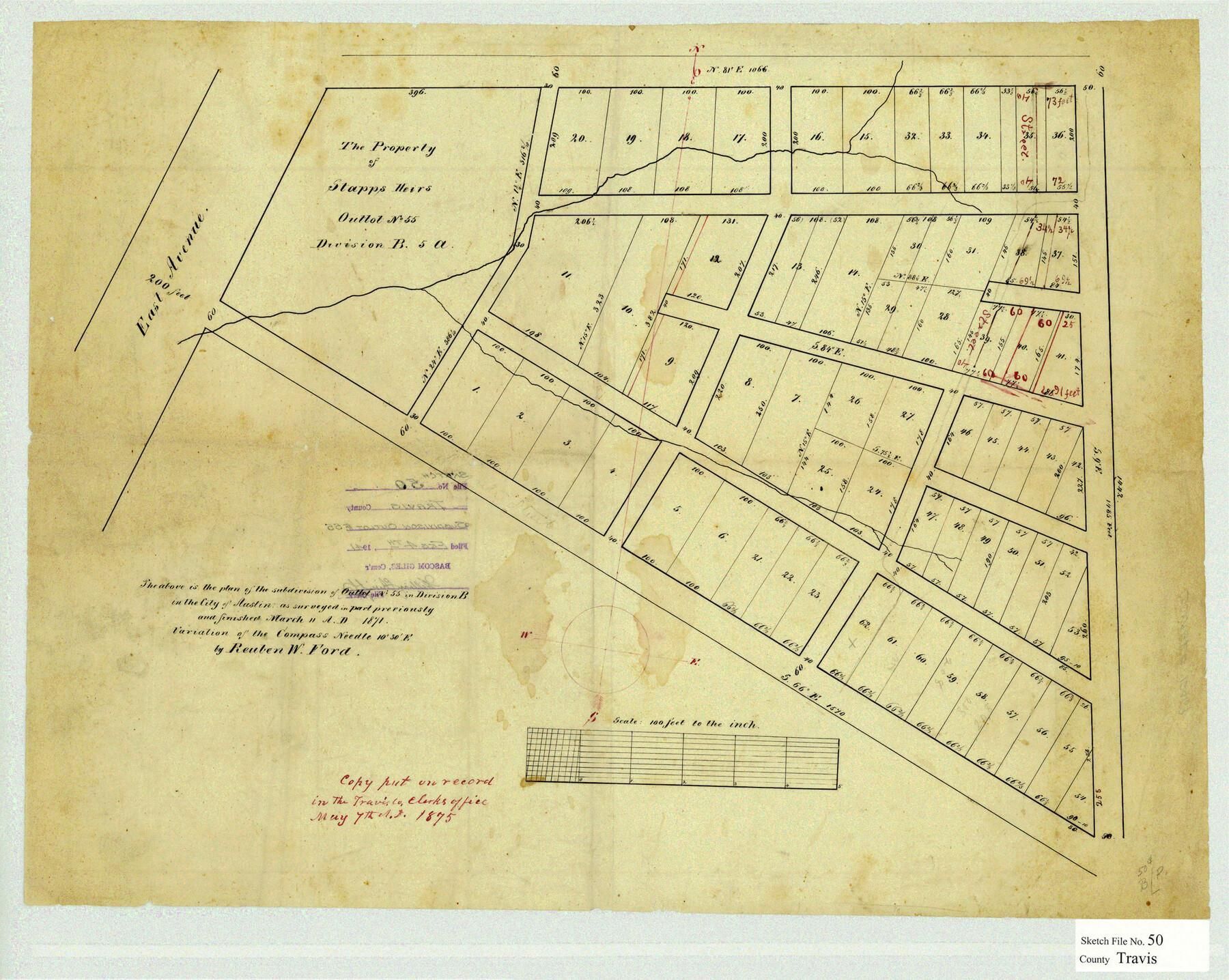
Figure 1: [Sketch of the Subdivision Outlot No. 55, Division B, Travis County, Texas]
The land within this outlot formed the early core of Robertson Hill, though the community would extend much further south and east in subsequent years, eventually reaching East 11th Street, Chincapin Street (now Rosewood Avenue), Leona Street, East Avenue, and East 14th Street.(3) It also grew to encompass the Pleasant Hill community as well in subsequent years.
The Robertsons began selling lots from their estate in the late 1860s to help them recover financially. Dr. Joseph W. Robertson was among Texas’ earliest colonists who settled in the then Republic of Texas in 1836 and served as a Texas Ranger in 1838.(4) He practiced medicine in Bastrop and Austin and, in 1848, purchased the former home of DuBois de Saligny, known as the Old French Legation, along with dozens of adjacent acres. Dr. Joseph Robertson was an enslaver, reporting ownership over nine enslaved persons in both the 1850 and 1860 Slave Schedules, a considerable number of enslaved people relative to the average enslaver in the area.(5) Elected Mayor of Austin in 1853, Robertson was venerated by Austin’s elite for his continued military service and acumen as a land speculator as well. When he fell ill from Tuberculosis, he bequeathed all of his estate to his son, George L. Robertson, a former Confederate soldier seriously wounded during the Civil War, empowering him to dispose of his real and personal property as he saw necessary to provide for his mother and seven siblings in the future.(6) George L. Robertson subdivided Outlot 55 of Division “B” of the City of Austin’s Outlots, and he and his father began selling lots to freedpersons in the summer of 1869, catalyzing the early formation of a freedmen’s settlement known as Robertson’s Hill.
The first freedperson to purchase land from the Robertsons in Outlot No. 55 was Malick Wilson, who purchased lot 6 from Joseph W. Robertson on December 25th of 1869 for $100.(7) On March 15th of the following year Andrew and Lucy Jackson purchased lot 4 from Joseph W. Robertson, and a month later on April 15th William and Eliza Saunders purchased lot 7 from him for $80.(8) On August 16th, Anderson Majors purchased lot 22 for $100 from Joseph W. Robertson, and it appears following Roberton’s passing his son’s George L. and L. L. proceeded with the disposition of the surrounding lots.(9) On March 22nd of 1871, Eliza Bell purchased lot 21 from George L. Robertson for $80 and Thomas and Julia Pease's lot 26 for $100, also from George L. Robertson.(10)
The Robertsons sold land from Outlot No. 55 to non-Black families as well, some of whom would later sell plots to freedpersons. For example, Captain John H. Connor, a Lenape tribe leader in Delaware and a former Texas Ranger, sold the western half of lot 13 from Robertson’s subdivision of Outlot 55 to a freedwoman named Martha James on November 3rd, 1871.(11) He wrote in the deed of sale that he received $300 coin in hand from “Martha James, freedwoman, formerly my slave” in exchange for the plot. Enumerated in the 1870 census as Martha Connor, it appears Martha lived near the Robertsons’ property with her daughters Susannah and Elizabeth, before this sale.(12) Another family who purchased land from Outlot No. 55 during this time period was the Moores. Albert and Fannie Moore purchased the southern half of lot 19 for $200 from Thomas and Sarah C. Jameson on September 19, 1872.(13) Several other freedpersons also purchased land from Outlot No. 55 and other tracts from the Robertsons’ estate in subsequent years, such as Outlot No. 66.
The relocation of a colored school, the “West Texas Conference School”, from the premises of Wesley Chapel Methodist Episcopal Church to a plot of land on Robertson Hill’s western edge further contributed to the area’s development and encouraged the location of colored educational institutions in the area.(14) The Freedmen’s Aid Society purchased six acres of land to construct a private school in East Austin (later Samuel Huston College) in 1882, though construction stalled for several years due to a lack of funding. The Robertson Hill Public School was established and opened for classes in 1884, further drawing Black families to settle on adjacent lands in the area. Located at the southeastern corner of East 11th and San Marcos Streets at the rear of the Ebenezer Baptist Church property, the Robertson Hill school was the first public school dedicated to African American students in Austin.(15) The Robertson Hill school’s enrollment increased from 84 in 1896 to 177 by 1904.(16) The West Texas Conference decided to reopen their school at Simpson Methodist Church nearby, and by 1898, completed their basement, which served as “a rudimentary classroom.”(17) This school was renamed Samuel Huston College in November of 1900, under the leadership of President Reuben Shannon Lovinggood of Wiley College and the school’s all-Black faculty.
The Robertson Hill community remained significant in Austin through the turn of the century, both because of its growing residential base and the varied social and educational institutions located within or adjacent to it. Commencement exercises at Robertson Hill High School were often held in local church buildings, perhaps to accommodate crowds. For example, in 1903, the school's graduation exercises, led by principal L.C. Anderson, were held at Wesley Chapel M. E. Church, where three students graduated: Lula Johnson, Rosa Beatrice Wilson, and Eddie Tecumseh Yerwood.(18) The 1904 graduating class, composing students Johnie Rudolph Johns and Richetta Juanita Woods, as well as the 1905 class, composing student Nancy Waterine Foster, Bessie Lydia Grant, Pearl Ellen Bertha Manning, and Lawrence Owens, also had their commencement exercises at Wesley Chapel, M.E. The 1906 commencement was hosted by the Metropolitan A.M.E. church, where the following students graduated: Jerry Lee Foster, Grant Sherman Frazier, Aaron Frederick Fuller, Adolphous Lorenzo Hall, Herbert Spencer Lawson, Effie Ester White, Kattie Mae Williams, and Monroe Carew Wilson. Robertson Hill High School was renamed Anderson High School by 1909 after Principal L.C. Anderson’s brother, E.H. Anderson, an educator.(19)
Works Cited
(1) Michelle Mears, And Grace Will Lead Me Home: African American Freedmen Communities of Austin, Texas, 1865-1928 (Texas Tech University Press, 2009): 40-42; Dolman, Wilson E., Barry W. Hutcheson, and Terri Myers, “East Austin Historic Sites Inventory, Robertson Hill, Austin, Travis County, Texas,” Preservation Central Inc. for Texas Historical Commission, October 2006, 7.
(2) Reuben W. Ford, “Travis County Sketch File 50, [Sketch of the Subdivision Outlot No. 55, Division B, Travis County, Texas],”
Texas General Land Office, March 3, 1871.
(3) Texas Historical Commission, “French Legation History,” Texas State Historical Sites, https://thc.texas.gov/state-historic-sites/french-legation/french-legation-history.
(4) Thomas W. Cutter, “Joseph William Robertson: Physician, Public Official, and Texas Ranger,” Texas State Historical Association, Texas State Historical Association; Texas Historical Commission, “French Legation History.”
(5) 1850 U.S. Federal Census, Travis County, TX, Slave Schedule, p. 317; 1860 U.S. Federal Census, Travis County, TX, Slave Schedule, p. 456.
(6)Texas Historical Commission, “French Legation History,”; Thomas W. Cutter, “Joseph William Robertson: Physician, Public Official, and Texas Ranger.”
(7) Travis County Clerk’s Office, “Deed of Sale from Joseph W. Robertson to Malick Wilson,”
Deed Record T (January 1870 to December 1870):
411-412.
(8) Travis County Clerk’s Office, “Deed of Sale from Joseph W. Robertson to Andrew and Lucy Jackson,”
Deed Record T (January 1870 to December 1870):
148; Travis County Clerk’s Office, “Deed of Sale from Joseph W. Robertson to William and Eliza Saunders,”
Deed Record T (January 1870 to December 1870):
235.
(9) Travis County Clerk’s Office, “Deed of Sale from Joseph W. Robertson to Andrew Majors,”
Deed Record T (January 1870 to December 1870):
559.
(10) Travis County Clerk’s Office, “Deed of Sale from George L. to Eliza Bell,”
Deed Record U (December 1870 to May 1871):
493-494; Travis County Clerk’s Office, “Deed of Sale from George L. Robertson to Thomas and Julia Pease,”
Deed Record U (December 1870 to May 1871):
480.
(11) Texas General Land Office, “Devoted to Peace — Delaware Chief John Conner,” Connor,
Save Texas History,
Medium, November 17, 2016; Travis County Clerk’s Office, “Deed of Sale from John H. Connor to Martha James,”
Deed Record V (March 1871 to January 1872):
663.
(12) U. S. Federal Census, Travis County Population Schedules, Austin, Page 7, Family Number 59.
(13) Travis County Clerk’s Office, “Deed of Sale from Thomas Jameson and Wife to Albert and Fannie Moore,”
Deed Record X (Transcript) (August 1872 to March 1873): 66-67.
(14) Wilhelmina E. Perry and August N. Swain,
The Huston-Tillotson University Legacy: A Historical Treasure,
Huston-Tillotson Alumni Association (2007).
(15) Dolman, Wilson E., Barry W. Hutcheson, and Terri Myers, “East Austin Historic Sites Inventory, Robertson Hill, Austin, Travis County, Texas,”
Preservation Central Inc. for Texas Historical Commission, October (2006): 23-24.
(16) J. Mason Brewer (ed),
An Historical Outline of The Negro in Travis County, Samuel Huston College (August, 1940): 31.
(17) National Register of Historic Places, Registration Form: Huston-Tillotson College, U.S. Department of the Interior, 25.
(18) Austin History Center, “[Transcripts of Commencement Exercises at Robertson Hill HIgh School],” Robertson Hill School File.
(19) Texas Historical Commission, “Invitation to the Dedications of the Texas Historical Markers 1. Laurine Cecil Anderson 2. Sites of Old Anderson High, Kealing Junior High School, November 1, 1987.
Map provided by Austin Parks and Recreation Department, Oakwood Cemetery Chapel, exhibit “To Emancipate”.
Click on the map to zoom in and explore a specific community.To view a full list of all communities, click the “i” icon in the top-left corner of the map.
